
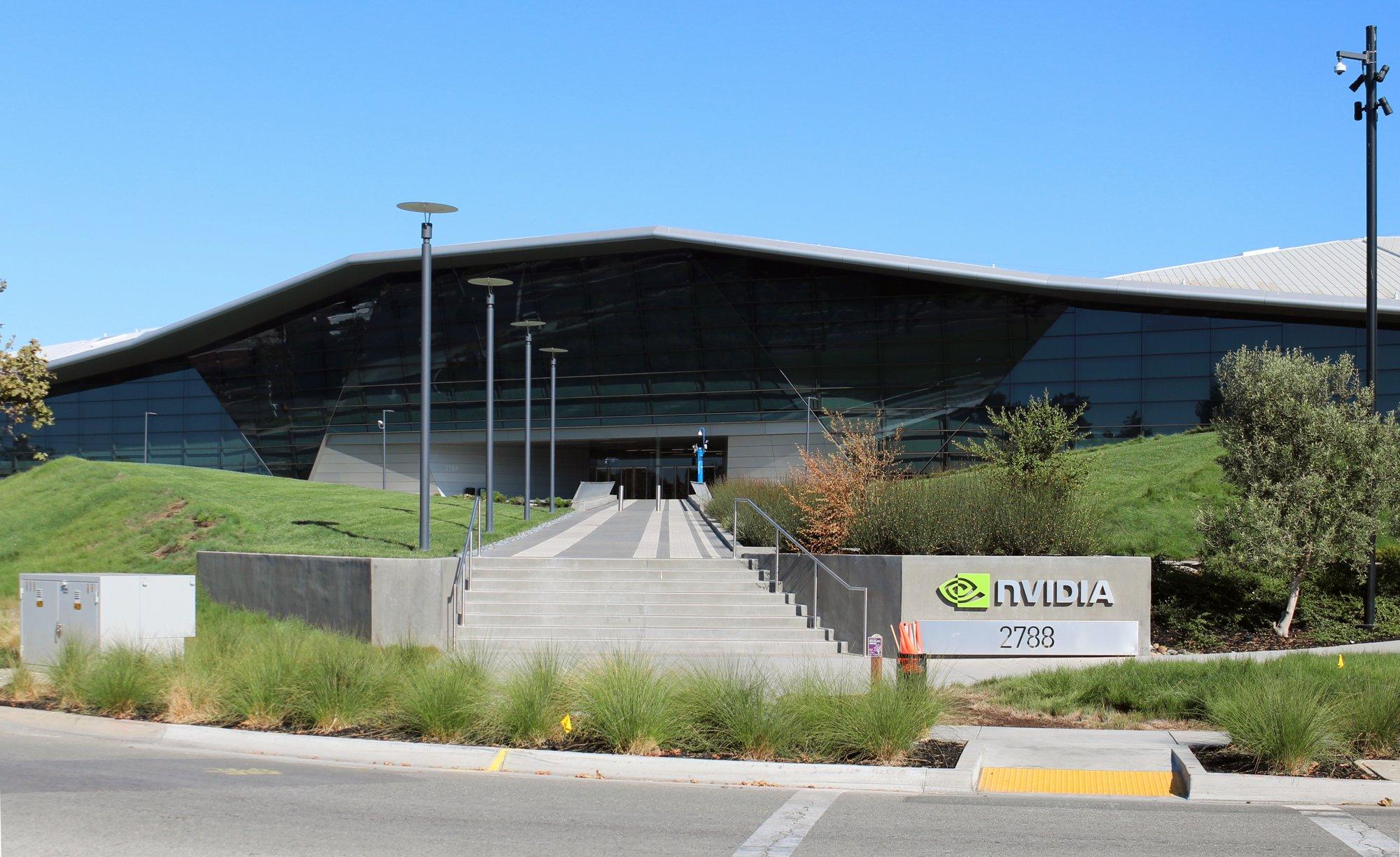
Nvidia’s week was not a 2.4 percent drift, and the stock is not on an eight-session break in the AI trade. The shares closed Friday, 16 October 2026, at $214.13, down $3.10, or 1.43 percent, from Thursday’s $217.23. From the 9 October close of $229.28 the week is down $15.15, or 6.61 percent. The last 90 daily log-returns, carried across the 52 New York sessions from 19 October through 31 December, put the bull at $279.89, the base at $217.64 and the bear at $184.04.
The missing fact is the size of Friday against the stock’s own tape. Friday’s log-return was -0.01437, or 0.62 of the sample standard deviation of 0.02326 on those 90 sessions. Tuesday 13 October closed up, at $228.52, so Nvidia itself was not on a straight losing run into the weekend. A 1.43 percent close is ordinary noise for this name. Jensen Huang’s Berlin line, reported the next day, added no order and no new revenue guide.
Key facts
- Friday 16 October 2026 official close $214.13, down $3.10, or 1.43 percent, from Thursday’s $217.23. Open $216.56, high $218.676, low $213.32, volume 121,252,500. Source: Nasdaq historical prices, file saved 18 October 2026. The last row is 16 October.
- Thursday 15 October closed at $217.23, down $4.07, or 1.84 percent, from Wednesday’s $221.30. From the 9 October close of $229.28 the week is down 6.61 percent. The 2.4 percent week is not in this file. Same Nasdaq file, saved 18 October 2026.
- The 6 October high was $243.37 and that day’s close was $239.24, the highest close in the file. Friday is 12.01 percent under the high and 10.50 percent under that close. The low in the file is $164.27 on 30 March 2026. Nasdaq’s summary, saved 18 October, prints the range as $243.37 / $164.27.
- That summary lists a market cap of $5,160,533,000,000, which is $214.13 times 24.1 billion shares, a one-year target of $315.00, average volume of 115,086,084 and a 0.46 percent yield on a $1.00 dividend. 24/7 Wall St. printed $5.17 trillion on 17 October. This note uses Nasdaq and does not average the two.
- Quarter ended 26 July 2026: revenue $96.2 billion, up 106 percent from a year earlier. GAAP and non-GAAP gross margin both 75.0 percent. Non-GAAP earnings $2.22 a diluted share. Data Center revenue $89.0 billion. Source: Nvidia’s 26 August 2026 release.
- The same release guides the next quarter to $108.0 billion, plus or minus 2 percent, so $105.84 billion to $110.16 billion, and gross margin to 74.0 percent, plus or minus 50 basis points. It assumes no Data Center compute revenue from China. The investor-events page fetched 18 October lists no November date.
- MarketBeat, fetched 18 October, shows 55 analysts, an average twelve-month target of $321.89, a high of $515.00 and a low of $210.00, which it calls 50.32 percent above $214.13. The split is 1 hold, 49 buy and 5 strong buy. Its earnings page estimates Wednesday 18 November 2026 and says Nvidia has not confirmed the date.
- House path, not a street target: N = 52, mu = 0.0003125798, sigma = 0.0232568271. Bull $279.89, base $217.64, bear $184.04. A FinanceFeeds pair from the 12 October close used $296.21 and $189.15. This pair is not within $1 on both numbers, so the horizon stays 31 December.
What just happened, and why the obvious reading is wrong
The obvious reading is that the AI trade broke and Nvidia confirmed it near $214. Two figures in that reading fail the file. The week is not about 2.4 percent. ($214.13 – $229.28) / $229.28 is -6.61 percent. And the stock did not fall in a straight line. Seven of the next eight sessions fell, and Tuesday 13 October rose.
The up day is the point. On Tuesday 13 October the close was $228.52, up $2.20 from Monday’s $226.32. A semiconductor-index streak, if one is being claimed elsewhere, is not Nvidia’s own closes. The largest down close in the run was Wednesday 14 October, from $228.52 to $221.30, a log-return of about 1.38 sample deviations. Friday, at 0.62 of a deviation, was the smaller day.
A one-deviation band around Friday runs from $209.21 to $219.17, because exp(0.0232568271) – 1 is 2.35 percent. Friday sits inside the band Thursday already implied. The drop from the $239.24 close is about 1.69 deviations over eight sessions, and the week is about 1.31 over five. The closes used here are the Nasdaq rows saved on 18 October.
Omor Ibne Ehsan at 24/7 Wall St. matched the $214.13 close and described an eighth down day for the semiconductor index. His oil, yield and after-hours figures are not in this file. The chart bar stays the official close.
Who is exposed
Equity holders take the first loss, and the scale is the market cap. Nasdaq’s $5,160,533,000,000 is Friday’s close times 24.1 billion shares. On that same count, the week’s $15.15 decline is $365.115 billion of market value. That is arithmetic, not a second official cap. No October filing fetched here updates the share count.
The company is also a buyer. The 26 August release says about $99.0 billion of repurchase authorization remained after $26.0 billion returned in the July quarter. At $214.13 that remainder is about 462.3 million shares, 1.92 percent of the count. No October page fetched here updates it.
Customers sit in one line. Data Center revenue of $89.0 billion was 92.5 percent of the $96.2 billion quarter. Edge Computing was $7.2 billion, or 7.5 percent. A guide of $108.0 billion, plus or minus 2 percent, is a Data Center statement. The desk record of that quarter is separate from this path. The path uses the release because no October revision was in the pages fetched.
The other holders are the buyers, the renters and the index books. CoreWeave’s band is a renter’s case, not an input here. Broadcom’s 4.35 percent drop was an earlier customer fight. The 8 October close of $230.48, down 2.94 percent, already carried the revenue argument. This note does not re-try it.
What the tape and the August release show
No new revenue figure arrived with Friday’s close. The tape and the 26 August release answer a narrower question than a broken AI trade.
| Item | Obvious reading | What the record shows |
|---|---|---|
| The week | About 2.4 percent, a pause | 9 October $229.28 to 16 October $214.13, down $15.15, or 6.61 percent |
| Friday | The break | $214.13, down 1.43 percent. Log-return -0.01437, or 0.62 of the 90-session sample deviation |
| The streak | Eight down sessions | 13 October closed up 0.97 percent, at $228.52. Seven of the eight sessions from 7 October fell. One did not |
| 14 October | The same as Friday | $221.30, down 3.16 percent from $228.52, about 1.38 sample deviations. The large day was Wednesday |
| The high | A distant peak | 6 October high $243.37, close $239.24. Friday is 12.01 percent under the high and 10.50 percent under that close |
| Year to date | The rally is over | 2 January close $188.85 to $214.13, up $25.28, or 13.39 percent |
| The guide | Management cut it this week | 26 August: third-quarter revenue $108.0 billion, plus or minus 2 percent. No October revision in the pages fetched |
| Street targets | The title bull and bear | Nasdaq one-year target $315.00. MarketBeat average $321.89. This bull is $279.89 and this bear is $184.04 |
Gross margin of 75.0 percent steps to a 74.0 percent guide, plus or minus 50 basis points. Non-GAAP earnings were $2.22. The release assumes no Data Center compute revenue from China, and Friday did not change that sentence. From the 2 January close of $188.85 the stock is still up 13.39 percent.
What Nvidia and named officials have said
The last full statement from the chief executive in a company document is 26 August, not this week. Jensen Huang, founder and chief executive, said in that release: “AI has reached its inflection point. It’s doing useful work. Its tokens are productive and profitable. Now, compute is revenue.” He also said: “The AI infrastructure buildout is at full steam. Vera Rubin, now in full production, was built to power exactly this moment.” Those lines do not mention a share price.
The sentence that traveled with Friday is a different page. 24/7 Wall St. says that in Berlin on Friday he answered: “All of this is going to pass, and the reason for that is very simple.” He added: “It’s going to be transformative. It’s going to impact in a very positive way every single industry and every single country. There’s no question it will continue, and we’re at the beginning of that.” He names no order and no new guide in that answer. A Sunday post carries only the shorter line and attributes it to Huang.
The company account named customers and no new revenue figure. On Thursday night in London, the account said Huang announced investments in Boltz, Foresight Works, Hiverge, PrimaMente and Riverlane. An earlier post committed $250 million of computing access over five years to UK research on AI agent safety, 0.23 percent of the $108.0 billion midpoint. Friday’s pre-open post expanded the Mercedes-Benz partnership. Other Thursday posts named Volvo Cars and a Stockholm event, and one ended “Next stop: Berlin.” None revises the guide, and the close still fell 1.43 percent.
The London remarks on China are from Wednesday evening, as CNBC reported on 15 October and updated on 16 October. Huang said: “We absolutely should work with each other so that we advance the technology safely.” He added: “We ought to enhance the dialogue.” A Chinese readout, as CNBC quotes it, has President Xi saying: “The two sides can continue their dialogue on AI, exchange views on its risks and benefits, and jointly prevent the misuse and abuse of AI.” Dialogue is not a license. The August outlook still assumes no China Data Center compute revenue.
The same MarketBeat table, which is ratings rather than quotations, shows Aaron Rakers at Wells Fargo at $210.00 on 2 October, Joseph Moore at Morgan Stanley at $230.00 that day, and C.J. Muse at Cantor Fitzgerald at $350.00 on 1 October. Simon Leopold at Raymond James is the $515.00 high, from 27 August.
The regulatory and macro tension
Friday resolved neither constraint on the guide. China compute is already out of the $108.0 billion outlook. A London call for dialogue does not put it back until a filing says so.
The second is permission to build. A data-center moratorium is already a separate note on this desk, not a line in the October posts. If a pause cut spending, the $108.0 billion guide is the number that moves. 24/7 Wall St. cites about $1.3 trillion of top-five hyperscaler capital spending in 2027. That figure is his, not in the release fetched here, and it is not an input to the bull or the bear. Volume does not show a capitulation: 121,252,500 shares versus Nasdaq average volume of 115,086,084, about 5.4 percent above average.
Bull, base, and bear through 31 December
These three prices are not analyst targets. They are a distribution around the drift of the last 90 daily log-returns. A log-return is the natural log of one official close divided by the prior close. Mu is the average. Sigma is the sample standard deviation, divided by n minus 1. The prior close for the first return in the window is 9 June 2026. The last return is Friday’s.
Mu is 0.0003125798. Sigma is 0.0232568271. N is 52, the sessions after Friday through Thursday 31 December 2026. The count starts Monday 19 October, skips weekends, and skips only Thursday 26 November and Friday 25 December. Friday 27 November and Thursday 24 December are early closes and still count. The base is the spot times exp(N times mu). The bull adds 1.5 standard deviations of the N-session window. The bear subtracts one. The drift is positive, so the bull does not need a no-drift fallback.
In steps: 52 times 0.0003125798 is 0.01625. Sigma times the square root of 52 is 0.16767. The bull’s exponent is 0.01625 plus 1.5 times 0.16767, or 0.26775. The bear’s exponent is 0.01625 minus 0.16767, or -0.15141. Applied to $214.13 and rounded to the cent, the base is $217.64, the bull is $279.89 and the bear is $184.04. The base is $3.51, or 1.64 percent, above the close. The bull is $65.76, or 30.71 percent, above it. The bear is $30.09, or 14.05 percent, below it.
| Case | Price | Versus $214.13 | What has to be true |
|---|---|---|---|
| Bull | $279.89 | Up 30.71 percent | Drift holds, and the path finishes 1.5 deviations above it |
| Base | $217.64 | Up 1.64 percent | Only the drift. No new guide is required |
| Bear | $184.04 | Down 14.05 percent | Drift minus one deviation. A print under $105.84 billion is the fundamental version |
Street targets are twelve-month opinions. Nasdaq’s $315.00 is $35.11 above this bull. MarketBeat’s $321.89 is $42.00 above it. Rakers’ $210.00 is $25.96 above this bear. The title pair is the formula, not that range. A FinanceFeeds pair from the 12 October close of $226.32 used $296.21 and $189.15. This bull is $16.32 lower and this bear is $5.11 lower, so the within-$1 rule does not shorten the horizon. N stays 52. The mean log-return is still positive after the slide, and 52 sessions of it lift the base only 1.64 percent.
What happens next
Monday 19 October is the next cash session. The exchanges are closed today, Sunday. If Monday’s official close lands between $209.21 and $219.17, it is inside one sample deviation of Friday and the volatility reading holds for another day. Friday was 0.62 of a deviation, and the company posts saved through Sunday morning did not change the $108.0 billion guide. A Monday close under $209.21 would be a fresh one-deviation down day. That would not prove a broken order book, but it would retire the claim that the selling had already slowed to ordinary noise.
The company posts name Berlin and GTC as the next stop, with no clock in the saved account text. If that stop does not change the August guide, the base stays $217.64. A new order, a China license, or a cut to $108.0 billion would be the first company number since 26 August that belongs in the path. Mercedes and Volvo did not do that on Friday.
MarketBeat estimates Wednesday 18 November 2026 and says the date is unconfirmed. The events page fetched here has no November entry. If the estimate holds, the test is $105.84 billion to $110.16 billion, with gross margin of 74.0 percent plus or minus 50 basis points and no China Data Center compute revenue. Under $105.84 billion is the fundamental bear. Inside the band, the 31 December base stays $217.64. The bull at $279.89 still requires the upside tail, and the bear at $184.04 still requires one deviation the other way.
Frequently asked questions
Is the drop a break in the AI trade or the stock’s own volatility?
It is the stock’s own volatility, not a break in the AI trade. Friday’s log-return was -0.01437, or 0.62 of the 0.02326 sample deviation on the last 90 sessions. The week from 9 October is down 6.61 percent, about 1.31 deviations over five sessions. Nvidia also rose on 13 October, to $228.52, so this stock is not on an eight-day losing run. A new guide would be a break. Friday did not bring one.
How much did Nvidia stock fall on the week to Friday 16 October?
The week from the 9 October close of $229.28 to the 16 October close of $214.13 is down $15.15, or 6.61 percent. Thursday was the 1.84 percent day, from $221.30 to $217.23. Friday was down $3.10, or 1.43 percent. A 2.4 percent week is not in the Nasdaq file saved for this note. On a constant 24.1 billion shares, the $15.15 decline is $365.115 billion of market value.
Where do the year-end bull, base and bear sit?
The bull is $279.89, the base is $217.64 and the bear is $184.04. N is 52 sessions from 19 October through 31 December, skipping only 26 November and 25 December. Mu is 0.0003125798 and sigma is 0.0232568271. The base is the spot times exp(N times mu). The bull adds 1.5 deviations and the bear subtracts one. The base is 1.64 percent above $214.13, the bull is 30.71 percent above and the bear is 14.05 percent below.
Are those the same as Wall Street’s targets?
No. The title pair is the 90-day distribution through year-end. Nasdaq’s one-year target is $315.00. MarketBeat’s average of 55 twelve-month targets is $321.89, with a high of $515.00 and a low of $210.00. Aaron Rakers’ $210 and C.J. Muse’s $350 sit in that street range, not in this formula. This bull is $35.11 under Nasdaq’s $315. This bear is $25.96 under the $210 target. The methods are not the same number.
When does Nvidia report, and what is the guide?
MarketBeat estimates Wednesday 18 November 2026 and says Nvidia has not confirmed it. The investor-events page fetched on 18 October shows no November date, so this note does not treat 18 November as a company timestamp. The 26 August guide is third-quarter revenue of $108.0 billion, plus or minus 2 percent, or $105.84 billion to $110.16 billion, and gross margin of 74.0 percent, plus or minus 50 basis points, with no China Data Center compute revenue assumed.
What did Jensen Huang say about the selloff?
24/7 Wall St. reports that in Berlin on Friday he said: “All of this is going to pass, and the reason for that is very simple.” He added that it will be transformative for every industry and country, and that it is still the beginning. That answer named no order and no new guide. The August release said compute is now revenue and Vera Rubin is in full production. Neither line is an October forecast.
This is not financial advice.