
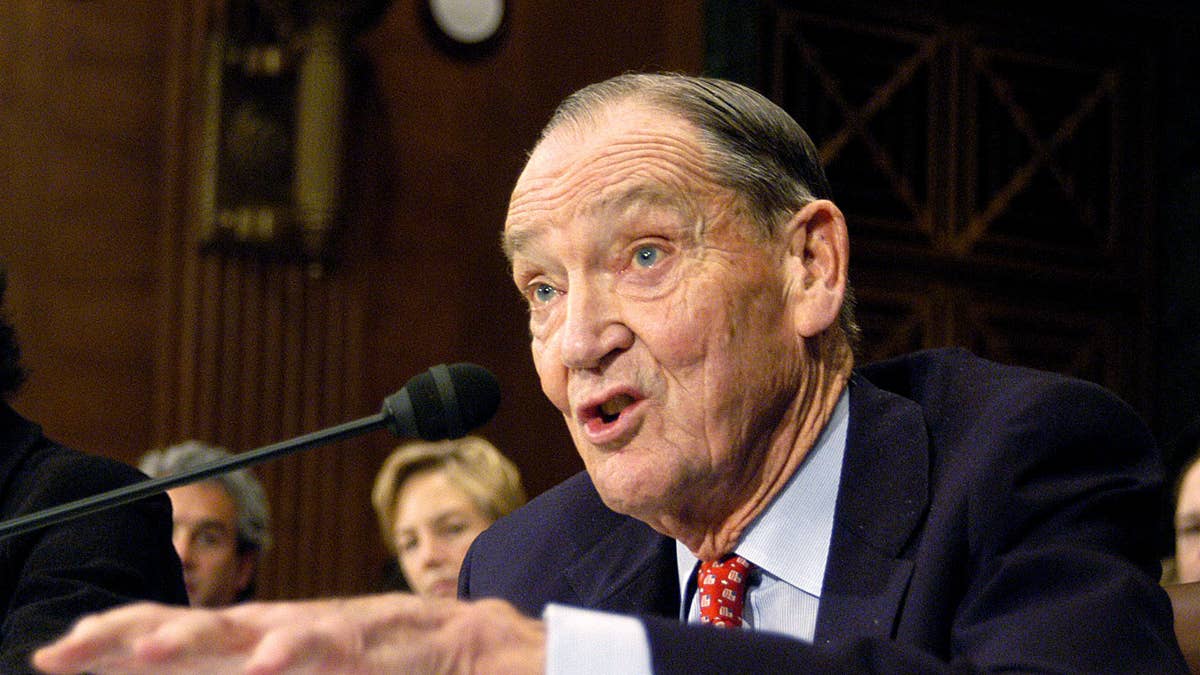
The late Vanguard founder Jack Bogle launched the first publicly available index fund in 1976, and the investing framework he built around it now shapes how millions of Americans save for retirement, college, and every financial goal in between.
A $100 monthly contribution to the Vanguard S&P 500 ETF (VOO) at its trailing 16-year annualized 15% return would compound into a six-figure balance over two decades, according to a Motley Fool analysis by Ben Gran. That kind of long-term compounding is what Bogle’s low-cost framework was designed to produce.
The amount of money now sitting in indexed funds across the United States has reached a level that would have been unthinkable when Bogle launched his first fund, and the gap between indexed and actively managed assets continues to widen each quarter.
Gran’s analysis distilled Bogle’s approach into a single sentence: “Nothing is simpler than owning the stock market and holding it forever.”
His piece explored what the flow numbers mean for investors still paying higher fees for active management, and why Bogle’s philosophy has only gained force in 2026.
Active fund managers keep falling short as index flows accelerate
The ICI’s July 2026 data captures the disparity in a single month. Long-term actively managed funds suffered $31.06 billion in net outflows, while index funds drew $123.84 billion in fresh capital.
The performance record explains the migration. The S&P Indices Versus Active (SPIVA) Year-End 2025 Scorecard found that 79% of actively managed large-cap equity funds in the United States trailed the S&P 500 over the full calendar year.
More S&P 500:
- Goldman Sachs drops one stat testing the S&P 500 bull case
- Buffett’s stark stock rule is hard to ignore at 5% yields
- S&P 500 analyst does an about-face on street-high target as Fed cracks down
Even in the first half of 2026, when broader market participation and small-cap outperformance created conditions that should have favored stock selection, 67% of large-cap managers still lagged the benchmark, the S&P Dow Jones Indices mid-year scorecard confirmed.
Each round of active fund underperformance pushes more capital into indexed strategies, raising the bar for the shrinking pool of managers still competing against the benchmark and making the next round of outflows more likely.
Bogle distilled his entire investment case into 12 words
Bogle spent four decades arguing that ordinary investors would build more wealth by owning the entire market than by paying professionals to select individual positions on their behalf.
He built Vanguard on the premise that broad diversification, rock-bottom costs, and patience would deliver stronger long-term results than active management, a thesis the scorecards have confirmed year after year.
Bogle condensed that argument into a single directive that became the foundation of the indexed investing movement.
<strong>Don't look for the needle in the haystack. Just buy the haystack</strong>.
Those 12 words underpin the indexed fund industry’s expansion into the single largest category of long-term investment assets in the United States.
A broad-market fund eliminates the cost and risk of individual stock picking and removes the emotional temptation to sell during downturns that damages long-term performance, Gran noted in the Motley Fool analysis.
Vanguard’s S&P 500 ETF shows what low costs deliver over 16 years
The Vanguard S&P 500 ETF (VOO) translates Bogle’s philosophy into a single ticker, and it recently became the first ETF in history to cross $1 trillion in net assets.
The fund holds about 500 large-cap U.S. stocks, tracks the S&P 500 index, and charges an annual expense ratio of 0.03%, which works out to $3 per year on a $10,000 investment.
Over the past 16 years since its 2010 inception, VOO has delivered average annual returns of about 15%, Ben Gran’s Motley Fool analysis noted, though he cautioned that the S&P 500’s longer-run historical average sits closer to 10%.
An active fund with a 0.50% annual expense ratio takes $50 per year on that same $10,000 balance, and those extra fees compound against a portfolio’s long-term returns each year they are deducted, Vanguard’s Principles for Investing Success research has documented.
Bogle argued throughout his career that expense ratios were among the most dependable predictors of long-term fund performance.
Lower-cost funds have consistently delivered higher net returns than higher-cost peers, Morningstar’s most recent U.S. Fund Fee Study has documented across multiple asset classes.
The SPIVA record shows the pattern extends across every equity category
The underperformance pattern extends well beyond the large-cap category that draws the most attention.
In the first half of 2026, 74% of mid-cap and 69% of small-cap active fund managers also trailed their respective benchmarks, Anu R. Ganti, head of U.S. Index Investment Strategy at S&P Dow Jones Indices, reported in the SPIVA mid-year scorecard.
Fund survivorship adds a layer of risk that the performance numbers alone do not capture. Active funds that underperform badly enough tend to merge or liquidate entirely, forcing shareholders to restart the selection process, as the SPIVA scorecards have documented.
Ganti’s research has tracked active fund failure rates across every major U.S. equity category, offering a clear reference point for investors comparing any actively managed holding in a 401(k) or brokerage account against a low-cost index alternative covering the same market segment.
The fund industry has spent decades building complex strategies to justify active management fees, and across every equity category Ganti’s scorecards have measured, Bogle’s 12-word alternative keeps delivering the stronger result for the investors who follow it.
Related: Mark Cuban delivers bold verdict on 5 popular investments