
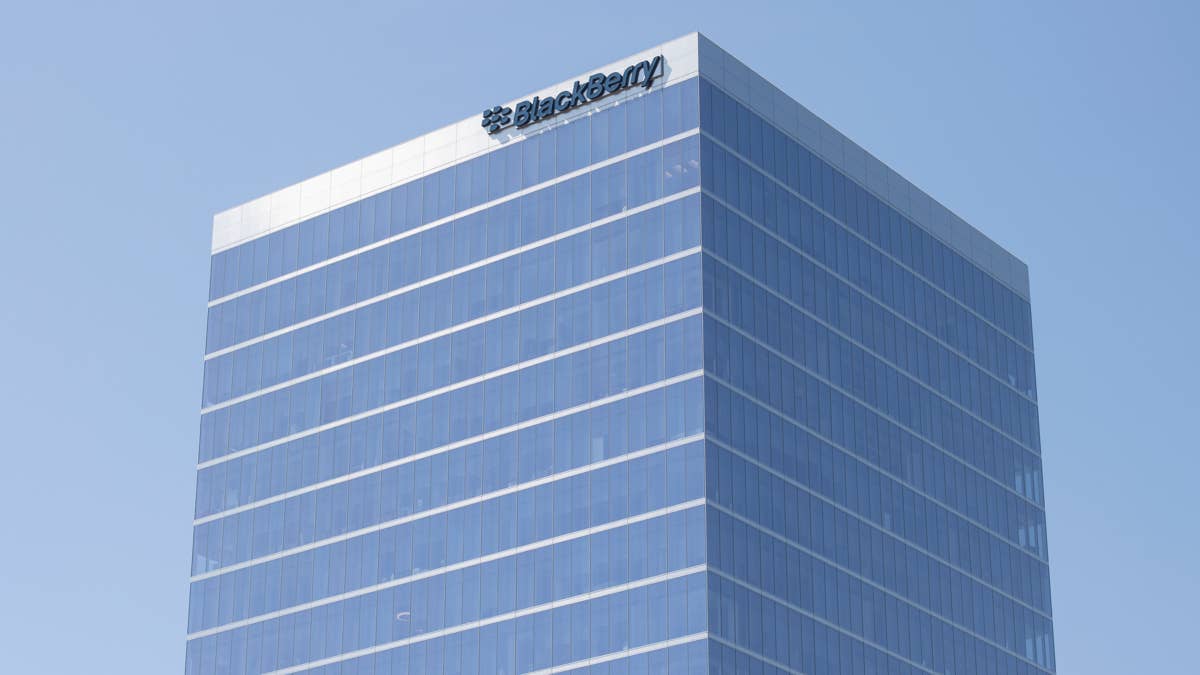
There was a time when carrying a BlackBerry was almost a status symbol.
Its small physical keyboard, flashing notification light and BlackBerry Messenger service helped define an age before Apple’s iPhone and Google’s Android operating system had changed the smartphone sector.
Eventually the smartphones vanished from the pockets of most customers.
The corporation didn’t do it.
Instead, BlackBerry (BB) has spent years trying to make one of the most radical transitions in technology away from the hardware that built its reputation and toward software that runs mainly out of sight.
That reinvention is becoming increasingly difficult to overlook.
BlackBerry estimates that it now has well over 275 million cars globally that run on its QNX software. Most drivers would intentionally interact with it. It is fundamental software for automotive systems as well as other embedded applications.
The erstwhile smartphone behemoth has now given another clue that its second act is gathering momentum.
Revenue jumped 26% in its latest quarter, profitability improved sharply, cash generation strengthened, and its automotive-software operation produced record revenue.
BlackBerry also scored what management calls the biggest QNX design success in the division’s history.
BlackBerry’s biggest business looks nothing like its old one
BlackBerry reported $163.3 million of revenue for its fiscal second quarter ended Aug. 31, up 26% year over year.
But the most telling statistic came from QNX.
The segment reported record quarterly revenue of $80.3 million, up 27% over the prior year.
QNX’s adjusted gross margin improved four percentage points to 87% and adjusted profits before interest, taxes, depreciation and amortization climbed 41% to $29 million.
Those numbers show how far BlackBerry has come from the days when customers recognized the firm.
QNX offers the fundamental software for software-defined automobiles, including operating systems and other technologies that supports more complicated automotive computing.
BlackBerry said it had already integrated its QNX software in more than 275 million cars across the globe.
QNX has design victories with all of the world’s top 10 automakers and 24 of the top 25 electric car manufacturers, the business has asserted in the past. Its automotive partners have included big technology businesses such as Amazon Web Services, Microsoft, Intel and Qualcomm.
That’s a strange relationship with the customer.
Someone who hasn’t touched a BlackBerry phone in over a decade might be utilizing BlackBerry technology every time they step behind the wheel.
And the company’s newest deal might dramatically increase that presence.
Related: Cramer sends unmistakable verdict on BlackBerry before earnings
BlackBerry said QNX scored its first design award for Alloy Kore, a platform to accelerate software-defined vehicle development.
Management called it the largest design win in QNX history.
Reports following BlackBerry’s results say the deal is with Coretura, the commercial vehicle software joint venture sponsored by Daimler Truck and Volvo Group, and adds more than $100 million to QNX’s royalty backlog.
This is more than just another car company relationship.
It gives BlackBerry future visibility as automakers and commercial-vehicle manufacturers pack more complex computer systems into their cars.
BlackBerry’s turnaround is showing up in its profits
The QNX milestone was part of a larger improvement in BlackBerry’s financial performance.
Adjusted EBITDA rose 81% year-over-year to $47 million.
Generally accepted accounting principles operating income climbed 192% to $33.6 million.
Adjusted net income increased 79% to $43.2 million, while adjusted earnings reached 7 cents per share.
BlackBerry had operational cash flow of $29.3 million, compared to just $3.4 million in the same period the previous year.
If anything, the protracted and often painful evolution of the firm makes the results even more telling, with BlackBerry posting its sixth straight quarter of positive GAAP net income, bringing in $33.9 million in the current period.
The company’s other big division, Secure Communication, is developing much more slowly.
Revenue in secure telecommunications climbed 2% to $60.9 million. Annual recurring revenue remained flat at $221 million, but the division’s adjusted EBITDA dropped 18% to $8 million.
Licensing contributed another $22.1 million of revenue and $20 million of adjusted EBITDA.
Those metrics make QNX even more critical to the growth narrative.
BlackBerry’s CEO John Giamatteo said the division’s record quarter was driven by its core automotive business and its pursuit of embedded markets and physical AI.
More Tech:
- Anthropic-powered AI model sends shocking message to employee
- Rocket Lab clears 1st hurdle in its biggest satellite deal
- Apple’s $54 billion iPhone machine may be about to break its biggest ritual
BlackBerry’s automotive possibility also represents a much larger phenomenon that is taking place inside modern cars.
Cars are increasingly reliant on huge quantities of software to run digital cockpits, driver-assistance systems, communications, and other operations.
It increases demand on the underlying operating systems and infrastructure that enable such apps to execute successfully.
Consumers might never see the BlackBerry name on their dashboards. But that’s precisely the point. BlackBerry no longer needs them to.
BlackBerry raises its outlook as its second act gains momentum
A better first half gives BlackBerry confidence to improve fiscal 2027 guidance for sales and adjusted EBITDA.
The corporation also ended the quarter with $447.1 million in cash and investments.
That financial situation matters because BlackBerry’s change hasn’t been a straight line.
One of the world’s most well-known smartphone makers, the firm has become one whose most essential technology is virtually invisible to the common user.
Its recent results show proof that the transformation is becoming more financially relevant.
Revenue increased 26%. Adjusted EBITDA jumped 81%. Operating cash flow improved by nearly $26 million from a year earlier.
And the fastest-growing primary company is QNX, whose software BlackBerry boasts is currently embedded in more than 275 million cars.
The Coretura deal adds still another layer.
QNX’s royalty backlog is said to have grown by over $100 million on a single design victory, providing the firm with potential income that might materialize once cars employing the platform enter production.
But there’s cause to be cautious.
It is expanding a lot slower, and its adjusted EBITDA was down in the quarter. Also, automotive design successes might take years to fully transfer into manufacturing revenues as well.
But the last quarter shows how significantly the BlackBerry narrative has altered.
The corporation that once competed with Apple and Android for space in consumers’ pockets has given up that fight.
Instead, BlackBerry has moved deeper inside the machines consumers use every day. Its phones may have disappeared. Its software increasingly hasn’t.
Related: Cathie Wood buys $25 million in tumbling tech stock