
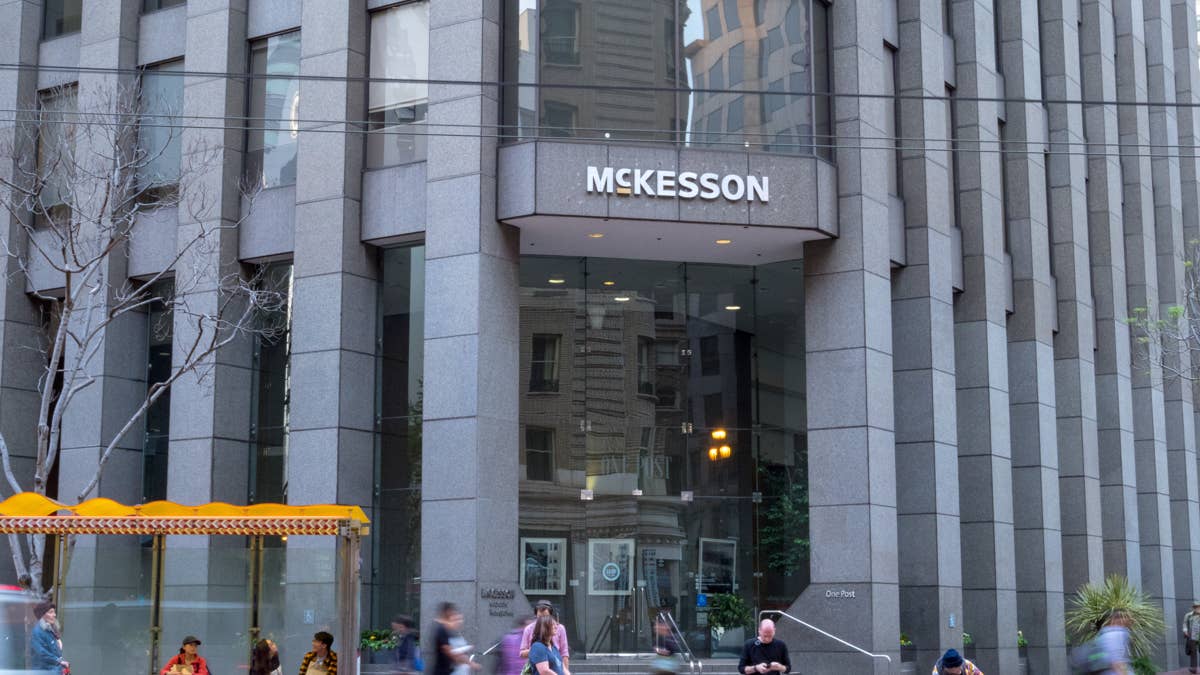
Option Care Health (OPCH) shares were up about 33% to $31.11 around midday Tuesday, Oct. 6, after McKesson and private-equity firm Clayton, Dubilier & Rice agreed to take the home-infusion provider private.
The buyers will pay $32.05 per share in cash, valuing Option Care at about $5.8 billion, including debt. The offer represents a roughly 37% premium to the stock’s Oct. 5 closing price.
McKesson (MCK) will not take control of the company when the deal closes. CD&R will own the majority, and McKesson will start with a minority stake under a structure that could eventually give it a path to acquire CD&R’s interest.
The investment gives McKesson a foothold in a nationwide network for delivering complex infusion therapies in patients’ homes and outpatient facilities.
McKesson is starting with 49% of Option Care
The ownership structure splits Option Care between McKesson and CD&R:
- CD&R: About 51%, giving the private-equity firm majority ownership.
- McKesson: About 49%, for an investment of roughly $1.4 billion.
- Future ownership: The agreement creates a framework for McKesson to acquire CD&R’s interest later, subject to specified conditions and regulatory approvals.
Option Care will remain a separate company led by its existing management team after the transaction closes.
Also read: Health insurance is about to cost you a lot more in 2027
McKesson plans to use the equity method to account for the stake. That means it will record its share of Option Care’s net income or loss instead of combining all of Option Care’s revenue and expenses with McKesson’s financial statements.
The companies have not disclosed a price or timetable for McKesson to acquire CD&R’s future stake.
McKesson therefore gets an economic stake in Option Care without taking full ownership at closing, with the possibility of increasing that ownership later.
Option Care gives McKesson a network outside the hospital
Home infusion allows patients to receive intravenous drugs at home. Option Care also administers therapies at ambulatory infusion centers and other nonhospital locations.
Option Care says it served more than 315,000 patients in 2025. Its network is in-network with the 10 largest payers and reaches about 96% of insured lives, according to the company’s investor materials.
Those payer relationships are important because insurance coverage helps determine whether a patient can receive therapy through the network and how Option Care is reimbursed.
McKesson already has a large specialty-care business. Its Oncology & Multispecialty segment generated $14.2 billion of revenue in its latest quarter, up 33% from a year earlier, driven by provider solutions and specialty distribution, including acquisitions.
Option Care adds a nationwide system for administering therapies after drugs move through the distribution chain.
McKesson CEO Brian Tyler said the deal fits the company’s push to expand access to complex therapies in lower-cost community settings, at or closer to home. McKesson also cited continued growth in specialty, rare, and orphan therapies as a reason that alternate infusion sites are becoming more important.
Option Care estimates the U.S. home-infusion industry could grow at a high-single-digit annual rate, driven by therapy growth, pressure to lower healthcare costs, and patient preferences, including aging at home. The forecast comes from Option Care management and is not guaranteed.
For McKesson, buying part of Option Care connects its specialty-drug business more closely with the places where some of those medicines are administered.
Slower growth puts Option Care’s takeover premium in focus
Option Care’s recent revenue growth has been modest. Second-quarter revenue increased 1.9% to $1.44 billion from a year earlier.
Three months earlier, CEO John Rademacher said management was not satisfied with the company’s revenue growth momentum after a mixed first quarter.
The $32.05 offer nevertheless values Option Care well above Monday’s closing price.
More Healthcare/Health:
- One IRA withdrawal can triple your Medicare premium
- UnitedHealth’s earnings comeback hides a risk Wall Street can’t price
- Medicare’s new $50 GLP-1 deal has a catch
McKesson and CD&R are buying an existing national infusion network with broad payer access at a time when both companies expect more complex treatments to move into home and outpatient settings.
The premium puts a price on more than Option Care’s near-term sales growth. The buyers are also paying for its clinical network, relationships with insurers, and position in a part of healthcare they expect to expand.
Option Care’s deal still needs shareholder and regulatory approval
The acquisition is expected to close in the first half of 2027.
Before that can happen, Option Care shareholders must approve the transaction, and the buyers must receive required regulatory approvals. Option Care will become privately held, and its shares will stop trading on Nasdaq after the deal closes.
The company’s next quarterly report will look different as a result.
Option Care plans to release third-quarter results on Nov. 4, but it will not hold its usual live earnings call. It also withdrew its previous 2026 financial guidance after announcing the acquisition.
For Option Care shareholders, the near-term outcome now depends largely on whether the $32.05 cash deal clears those approvals and closes on schedule.
For McKesson, the longer-term test is whether owning part of the network where specialty drugs are administered creates enough value to justify moving further into Option Care later.
Related: Walmart has a farmhouse storage cabinet with multiple compartments for $190